



Chinese equities have endured a volatile decade due to policy changes, geopolitical tensions and uneven growth. However, sentiment has swung too far into excessive pessimism, while China has made important structural progress that is now becoming more visible. The recent market recovery may mark the beginning of a more sustainable upturn. That is the view of William Russell, Head of Equity Product Specialists, Asia-Pacific, and Tessa Wong, Senior Product Specialist, at Allianz Global Investors.
Below are the ten most important reasons.
 William Russell |
1. Rapid technological progress and undervaluation
China surprised markets in early 2025 with DeepSeek, an AI model that performs comparably to ChatGPT at much lower costs. This fits into a broader trend of major advances in AI, robotics, autonomous driving, renewable energy and biotechnology.
China is now a global leader in areas such as electric vehicles, industrial robots, solar power production and AI patents. This technological strength creates new investment opportunities and shows that China is further ahead in various strategic fields than is often assumed.
2. Active support from the central bank
 Tessa Wong |
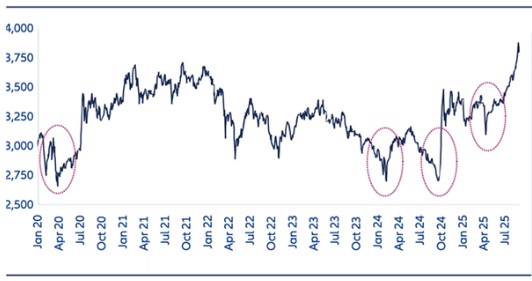
Shanghai Composite Index, 5 years
The Shanghai Composite has not traded for extended periods below 3,000 in recent years.
Source: Wind, Allianz Global Investors, as of 31 August 2025
3. Return of domestic investors
Foreign investors own only about 3% of A-shares; the market is dominated by Chinese investors. Due to low interest rates and high savings (around USD 7 trillion in excess deposits), more capital is shifting toward equities. Institutional investors such as insurers and pension funds are also likely to increase their equity allocations.
4. More buybacks and higher dividend payouts
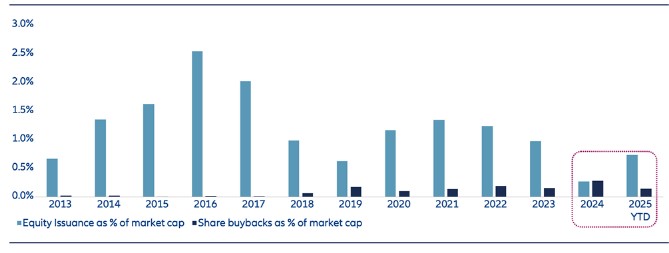
Chinese companies hold exceptionally high cash positions. Regulators are encouraging them to return more value to shareholders. As a result, share buybacks have increased significantly and more companies are paying interim dividends. This makes the market more attractive to both domestic and international investors.
5. Stricter policies on equity issuance
For years, a large number of IPOs weighed on market returns. Since 2024, stricter rules for listings and delistings have been in place. This reduces supply and improves the balance between equity supply and demand, supporting the market over the long term.
Equity issuance and share buybacks as a percentage of total market capitalization of Chinese A-shares
Source: Wind, Allianz Global Investors, as of 31 August 2025
6. Tariff risks have diminished
Although tensions between the U.S. and China persist, the acute risk of new tariffs has eased. China now holds a stronger position thanks to its dominant role in critical raw materials and production chains. At the same time, the country continues to focus on technological self-reliance, helping to better absorb future shocks.
7. Valuations remain attractive
The recent recovery has been driven mainly by higher valuations, but these remain around historical averages. Price-to-book ratios are reasonable, and the equity risk premium remains appealing, especially in a low-interest-rate environment.
8. Market trends diverging from macroeconomic pressures
Despite weak housing prices and lower exports, the stock market is benefiting from a shift in market structure: technology and growth sectors now make up an increasingly large share of the index. Sectors such as AI, robotics, EV supply chains and biotechnology have become the main growth drivers.
9. Property-sector problems easing
The real-estate crisis weighed on sentiment for years, but support measures such as lower mortgage rates and aid to developers are stabilizing the sector. The biggest downside risks appear to be behind us, as reflected in the strong rebound of high-yield property bonds.
10. Low correlation with global equities
Chinese A-shares move relatively independently from other markets (correlation 0.34 with global equities). This makes them valuable for diversification and can improve the risk-return profile of a global portfolio.
Conclusion
Although macro- and geopolitical risks remain, China has undergone structural improvements: technological strength, abundant domestic liquidity, a more attractive market structure and increasing government support. Domestic companies are also increasingly well positioned to benefit from China’s growth. Therefore, a renewed consideration of Chinese equities may be worthwhile in a global portfolio.
