



- Sell-off in U.S. ETFs
- ETF investors shift to European equities
- Demand for government bond ETFs also rising
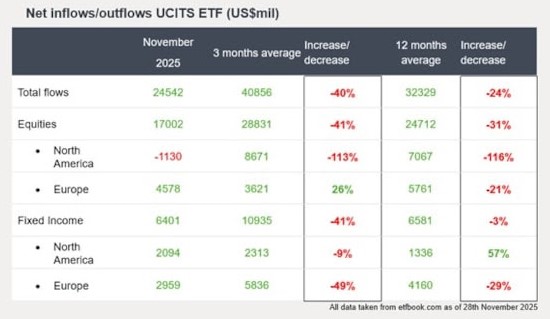
After a very strong autumn, the UCITS ETF market took a short breather in November, growing by “only” about 25 billion U.S. dollars — the third weakest month of the year. The main driver was outflows from U.S. ETFs* of just over 1 billion USD. “It’s telling of the ETF market’s strength that a comparatively weak month like November is still better than most months in 2024. This underscores the fundamental growth momentum of the ETF market,” says Stefan Kuhn, Head of ETF & Index Distribution, Europe, at Fidelity International.
On the other hand, the U.S. market remains volatile. November was the fifth month of the year with negative net inflows. Nevertheless, on a yearly basis, there’s still a strong gain of over 40 billion USD invested in U.S. ETFs. “The U.S. remains a hit-or-miss market because so much depends on AI. When there’s positive news, investment surges. When doubts grow, it goes the other way. That’s what happened again in November,” says Kuhn. Looking ahead to 2026, confidence in the AI rally is one of the key questions for investors. “We are constructive about the U.S. market’s development in 2026 — at least for the first half of the year. So there’s a good chance that in a year’s time we’ll see more green than red monthly figures for U.S. ETFs,” Kuhn adds.
Market Event of the Month: Leveraged ETFs in Trend
ETFs that replicate an index’s performance disproportionately are becoming increasingly popular among retail investors. On a yearly basis, net inflows into such leveraged ETFs amounted to around 400 million U.S. dollars. The overall UCITS market stands at just over 10 billion USD. “Leveraged ETFs are highly speculative instruments suitable, if at all, only for experienced investors,” says Kuhn. In addition to higher fees, leveraged ETFs are structurally disadvantaged compared to non-leveraged products due to technical effects such as ‘volatility drag.’ “If you’re looking for a bit of thrill, leveraged ETFs are the right place. If you want to invest for the long term, you should look elsewhere,” Kuhn concludes.
