


CIO Perspectives Degroof Petercam and Indosuez Wealth Management The US and Israel entered a broader and more intense conflict with Iran, marking a significant escalation from previous tensions. Oil remains the primary transmission channel for economic impact. In this note, we focus on the potential economic and market implications of this conflict and outline several scenarios to help navigate the current environment. At this stage, we believe it is premature to “buy the dip” and maintain our current asset allocation built around diversification, while monitoring developments closely.

By Alexandre Drabowicz, Global Chief Investment Officer, Jérôme van der Bruggen, Chief Market Strategist, Bénédicte Kukla, Chief Investment Strategist, Francis Tan, Chief Strategist Asia and Lucas Meric, Cross Asset Strategist
1. The risks of pricing in war
Over the weekend, hostilities between the US, Israel, and Iran intensified considerably, representing a clear escalation beyond prior tensions. However, markets had already started to price in the risk of such developments, as negotiations between the US and Iran appeared to stall. Last week, the US 10-year Treasury yield fell by 14 basis points (bps), and WTI oil prices rose by 6%, now nearly 20% higher year-to-date.
The duration and outcome of this conflict remain highly uncertain. As we are not geopolitical experts, we refrain from political commentary and instead focus on the potential economic and market implications. Oil remains the primary transmission channel for economic impact. Despite ongoing tensions in the Middle East, oil prices have struggled to rally meaningfully in 2024 or in 2025, as previous conflicts have been relatively contained and short-lived, with limited escalation and remaining regional in scope.
History suggests that reacting emotionally to geopolitical events is rarely a sound investment strategy. While markets may experience short-term volatility and risk-off moves, these reactions often prove temporary. As table 1 below illustrates, equity markets can suffer during escalations, but losses frequently reverse as tensions ease. Selling assets in response to such events may provide short-term reassurance, but re-entering the market can be challenging and may result in missed opportunities, impacting long-term returns.
At this stage, we believe it is premature to “buy the dip.” In this note, we outline several scenarios to help navigate the current environment. We wish safety to our colleagues and clients in the Middle East and hope for a swift resolution.
Table 1 : The historical impact of geopolitical events on S&P500
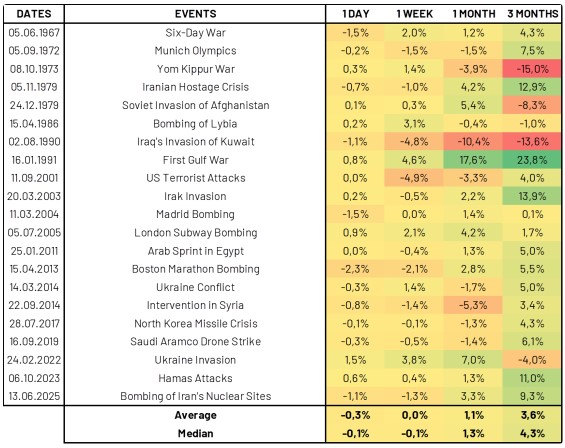
2. The market reaction appears relatively moderate Geopolitical events have historically been significant triggers of volatility in financial markets. Equity markets tend to decline in the initial days following a geopolitical event, or beforehand when tensions gradually escalate, before rebounding as the situation eases.
At the time of writing, the market reaction appears relatively moderate considering the weekend’s events: equity futures are down, the S&P 500 has fallen by 1%, and the Stoxx Europe 600 by 1.5%. However, energy and defence-related stocks are showing gains, while global government bond yields are rebounding despite an environment of heightened risk. The US 10-year yield is just below 4%, after dropping 30 bps since early February, in a context where investors have recently focused on downside market risks—whether stemming from AI-driven disruptions, concerns over private credit, or the gradual escalation of tensions between the United States and Iran.
Safe-haven assets are also on the rise, with gold up 2% and the dollar index up 0.7%. Oil prices have appreciated by 8%, with Brent crude reaching USD 78 per barrel. It is worth noting that tensions between the United States and Iran have been building gradually in recent weeks, and the oil price likely already included a geopolitical risk premium, at USD 70 per barrel before the weekend, with the equilibrium price estimated around USD 60 in a context of elevated supply. Furthermore, Sunday’s OPEC+ announcement of a 206’000 barrel per day production increase for April has likely helped to modestly ease pressure on oil prices.
3. Why oil matters for Global markets?
Beyond the military operations conducted by the various countries, the evolution of oil prices remains a key focus for investors seeking to assess the impact of these tensions on the global economy and financial markets. The main area of concern is the Strait of Hormuz, located southwest of Iran, through which nearly 20% of the world’s oil and Liquefied Natural Gas (LNG) production transits. Around 80% of oil exports via the strait are destined for Asia, with 40% going to China. Although this is not currently the base scenario and the Iranian administration has already stated it does not intend to close the Strait of Hormuz—through which it exports the majority of its oil production and which remains open despite a nearly 30% drop in traffic since last week, and with regional oil facilities so far unaffected—this remains a major risk that, according to studies, could drive oil prices above USD 100 per barrel.
A Dallas Federal Reserve (Fed) study conducted during the tensions between Israel and Iran in June 2025 estimated that a closure of the strait would result in a nearly 130 bps increase in US inflation. Ultimately, the impact of oil prices on the economy and markets will depend on the duration of the conflict: for now, predictive markets anticipate a possible resolution by the end of April, with a 70% probability (Polymarket). As a reference, estimates indicate that a sustained 10% increase in oil prices typically affects global growth by -10 to -20 bps and inflation by +20 to +40 bps. Oil prices have already risen by nearly 20% since February. Should this impact persist, it would be significant, though not sufficient, in our view, to justify recessionary dynamics from a macroeconomic perspective, as long as disruptions to oil flows—particularly through the Strait of Hormuz—remain limited.
4. Three scenarios ahead
The situation remains very fluid, but in the current context we see three possible outcomes:
Scenario 1: No escalation, but muddle through (base-line)
Iran muddles through, fighting is expected to subside within weeks, in line with predictive market expectations of a ceasefire by end of April. The Strait of Hormuz experiences shipping disruptions but remains open, and oil prices retrace to USD 60–70 per barrel as the geopolitical premium stabilises. Based on the information available at the time of writing, this scenario is the most probable.
Scenario 2: Escalation and recession risks
In this scenario, as the conflict escalates and the Iranian government is in a more desperate situation and Middle Eastern conflict broadens, the Strait of Hormuz closes with sustained disruptions reducing regional oil supply. The price of the barrel continues to rise above the already stressed geopolitical risk premium by another 20% approaching the 100 per barrel threshold, almost doubling from the International Energy Agency (IEA) December estimates that energy market fundamentals warrant a price closer to USD 60 per barrel given the current oil surplus. This would clearly be a stagflationary shock for the global economy. The impact of higher energy prices will pass through to higher global consumer price inflation, notably in emerging markets with high oil import intensity (Malaysia, India and Indonesia notably) weighing on trade balances and currencies. China is the world’s largest importer but has three massive buffers: diversification (alternative pipelines from Strait of Hormuz), massive strategic reserves and the rapid shift to renewable energies. In the US, this spike in gasoline prices could squeeze already fragile US low-income consumers combined with potential negative market effects would bring about more significant downside risks on the US economy. The impact of a more prolonged increase in natural gas prices would increase the pressure on already disgruntled energy-intensive manufacturing in Europe (and seriously jeopardise the German recovery), although it is important to keep in mind that Europe has more automatic stabilisers to protect consumers from this type of shock. From a financial market perspective, this scenario is negative for risky assets and would leave central bankers in a difficult balancing act offsetting risks to growth with higher inflation in 2026.
Scenario 3: De-escalation with medium-term regime change
A new Iranian government is formed and faced with international and regional political pressure, Iran significantly stops retaliating and resume negotiation talks with the international community. This would allow the US to declare victory for its home political base before the US midterm elections. In the medium-term US and Israeli actions will have contributed to an eventual regime alteration in Iran. This would restore a more stable regional balance with oil prices falling sharply, benefiting global growth. Oil prices could return to 50 USD per barrel as overcapacity remains the dominating scenario.
Conclusion
Although this weekend’s events have increased the probability of a stagflationary shock (our second scenario), it should be reminded that global oil intensity is meaningfully lower than in prior decades and financial transmission channels (Forex, credit) appear less vulnerable compared with prior crises, likely mitigating the shock. Also, although such a scenario involves Brent rising further, possibly to levels above USD 100 per barrel, OPEC maintains spare capacity to mitigate supply disruptions and exert influence over oil prices. Finally, our third scenario involves US and Israeli actions contributing to an eventual regime alteration in Iran—restoring a more stable regional balance— and oil prices falling sharply, benefiting global growth. While this remains uncertain and fraught with risks, it represents an important medium‑term bullish tail scenario for risk assets.
For now, despite elevated uncertainty, we therefore maintain our current asset allocation while monitoring developments closely. We remain invested in equities and highly diversified, balancing short‑term volatility with long‑term opportunity. Our view is also that current events will not alter the ongoing broadening out of the stock market rally to small‑ and mid-caps and sectors that were left behind. On the same note, we also maintain our emerging markets’ exposure as well our more recent investments in basic resources and defence sectors.
Our view that the US dollar has further room to weaken is challenged but maintained given some of the more structural developments (i.e. US deficits). Finally, our gold call continues to be vindicated as a hedge against geopolitical and inflation risks. The situation remains fluid, but disciplined positioning and broad diversification offer the strongest foundation for navigating the weeks ahead. In the March edition of our Monthly House View to be published shortly, we focus on increased diversification and the renewed importance of industrial metals.
By Alexandre Drabowicz, Global Chief Investment Officer, Jérôme van der Bruggen, Chief Market Strategist, Bénédicte Kukla, Chief Investment Strategist, Francis Tan, Chief Strategist Asia and Lucas Meric, Cross Asset Strategist.
