



By Francis Muyshondt.
With a range of active ETFs built on an in-house AI investment strategy, Pictet Asset Management aims to offer investors an extra return on top of that of traditional equity indices, without departing from their risk profile. According to Gabriele Susinno, Senior Client Portfolio Manager at Pictet, the approach targets an annual excess return of 1% after fees over the underlying index. In an interview, he explains how the underlying AI technology works, where the extra return is meant to come from and where its limitations lie. He also stresses that it is not a black box and that human intervention will always be needed.

What is it about?
At the end of June 2026, Pictet Asset Management launched four AI Enhanced ETFs that use the MSCI World, the S&P 500, the MSCI Europe and the MSCI World ex USA as their reference indices. The aim is to use an in-house AI-driven investment model, which Pictet introduced in March 2024, to achieve a higher return than the underlying indices without materially departing from their risk profile.
The difference from a traditional index tracker lies mainly in the composition of the underlying portfolio. Whereas the MSCI World, for example, contains around 1,350 stocks, the asset manager needs only 300 to 400 of them to largely replicate the index’s risk profile. To do so, Pictet uses methods like stratified sampling (i.e. efficient optimisation). This involves building a selection of stocks that collectively share the same characteristics as those in the index. In practice, this selection ensures that the portfolio stays as close as possible to the benchmark in terms of country, sector and factor exposure. ‘That is where artificial intelligence comes into play in putting it together,’ Susinno explains. ‘And incidentally, there are several possible combinations of stocks that have the same effect on replicating the benchmark.’
Extra return
In addition, the in-house AI model predicts which individual stocks will perform relatively better or worse than the index over the short term – a month at most. On that basis, Pictet can overweight stocks with favourable prospects, while less attractive companies are underweighted or left out of the portfolio altogether. ‘The result is a portfolio that differs considerably from the benchmark in its composition, but whose market sensitivity and risk profile match those of the index as closely as possible. So the extra return is not meant to come from large positions in particular sectors or investment styles, but from the selection and weighting of individual stocks,’ Susinno says, continuing his explanation of how the model works.
‘We are targeting annual outperformance of 1 to 1.5% after fees, with a tracking error of no more than 2%.’ In other words, he says, it is about systematically exploiting small company-specific differences in returns. It is explicitly not about predicting the absolute direction of equity markets. ‘Traditional quantitative investors try, as it were, to ride the big waves of the market. But when you look much closer to the surface of the water, you see all kinds of small ripples that appear and disappear. They have their own dynamics.’ It is precisely these small movements that Pictet seeks to predict with its AI model.
Capitalising on short-term moves
In classical financial theory, company-specific or idiosyncratic risks are regarded as risks for which investors receive no additional return PREMIUM , because they can largely be diversified away by spreading holdings across enough stocks. Price movements of individual companies that are not explained by general market developments or traditional risk factors are therefore often treated as largely unpredictable noise. But according to Susinno, that does not mean these movements are entirely random. ‘If you are able to determine their direction with even a small degree of predictability, you gain an edge.’ That is exactly what Pictet is trying to achieve with artificial intelligence: uncovering patterns in company-specific price movements that traditional models cannot detect.
The technology was developed within Pictet’s Quantitative Equities and Solutions Team (Quest), which has been active in quantitative investing since 1998. ‘The strategy originated in research into a more efficient way of rebalancing large quantitative portfolios without transaction costs eating up too much of the return,’ the Pictet manager explains.
Four hundred variables and thousands of decision trees
To make these predictions, Pictet uses machine learning. ‘The model now processes almost 400 different characteristics, or features, relating to company fundamentals, analyst expectations, market sentiment and price information, among other things.’ Notably, Pictet relies largely on conventional financial data to do so. ‘We don’t need satellite imagery or other exotic data sources,’ Susinno stresses. ‘It’s about how you combine the available information and what relationships you can derive from it.’ This, he says, is the fundamental difference from traditional quantitative models, which typically use a limited number of predefined relationships between financial variables.
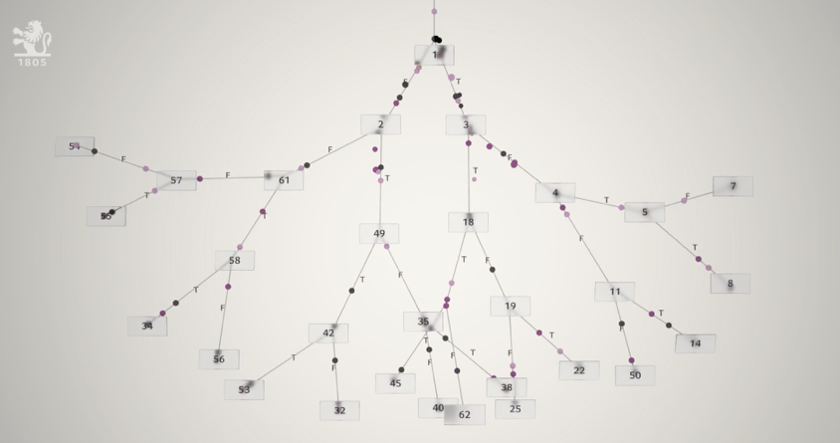
Machine learning, however, can recognise far more complex interactions. To that end, Pictet uses what are known as gradient boosted decision trees: algorithms in which large numbers of decision trees work together to improve predictions step by step. Susinno compares these decision trees to analysts who complement one another, with each new tree focusing on the errors and shortcomings of the previous ones. ‘We work with models made up of tens of thousands decision trees. You can think of them as thousands of analysts working together without any rivalry.’ The combined predictions ultimately form the basis for the individual stock weightings in the portfolio.
In the final construction of the portfolio, Pictet takes into account not only the AI model’s return forecasts, but also risks and transaction costs. The aim is to prevent the portfolio from deviating too far from the benchmark, or the expected extra return from being lost through buying and selling too many stocks.
Not chasing too much alpha
A key limitation of the approach is that the model’s predictions have only a short shelf life. As mentioned earlier, Pictet therefore focuses on a horizon of about one month. This means the signals cannot be used to build a concentrated portfolio with large active positions. ‘If we were to raise the tracking error substantially to extract more return from the predictions, we would undermine the reliability of the signals,’ says Susinno.
In his view, the strength of the approach lies in combining a great many small predictions within a broadly diversified portfolio. ‘You can generate a little extra alpha with this information. But if you get too greedy, you destroy everything.’ According to Susinno, that is also what sets the strategy apart from traditional active funds, which deliberately take large positions in particular sectors, style factors or market segments.
For passive investors, the whole point is that they largely retain their existing exposure to, say, the MSCI World or the S&P 500. The flip side is that the strategy will simply fall along with the underlying equity market when it corrects sharply. ‘The AI layer is not designed to protect investors against a general market downturn,’ the Pictet manager emphasises.
‘Generative AI is mainly a marketing tool’
Although Pictet is firmly committed to artificial intelligence, Susinno is strikingly critical of the use of generative AI to predict stock returns. His Team investigated whether large language models, such as the technology behind ChatGPT, could add value. ‘We looked at whether a large language model could give us an edge. But for predicting stock returns, we currently see no measurable added value. In that respect, it is mainly a marketing tool.’ The reason, according to Susinno, is that generative AI was not specifically designed to analyse complex, multidimensional numerical datasets.
‘We manage our clients’ money as if it were our own. So you have to understand why a model arrives at a particular decision.’ Pictet therefore spent more than two years developing techniques to explain the decisions made by its machine learning models. The goal was to turn the traditional black box into what Susinno calls a ‘crystal box’: a model whose predictions can be broken down and attributed to the underlying information. In his view, this transparency is essential for monitoring the strategy and developing it further.
$3.7 billion under management and growing
According to Susinno, interest in this approach to investing is growing. ‘We now manage around $3.7 billion in our AI-driven enhanced index strategies. This figure is steadily growing every month as investors are starting to embrace the concept.’ The track record has helped. Susinno says the global strategy has delivered cumulative outperformance of 2.2% after fees from its launch to the end of September 2026.
The new investors come mainly from the passive segment. ‘We see investors who started out fully passive but then begin to wonder whether a limited active component might be worthwhile. They don’t want to fundamentally change their core portfolio, but they are open to a little extra return.’ Pictet is thus explicitly positioning its active ETFs as an alternative to traditional index trackers, rather than as competitors to active equity funds.
To maintain this edge, Pictet is investing heavily in technology infrastructure. The Team now has its own servers with computing power of thousands of trillions of calculations per second. This in-house infrastructure is intended to make Pictet less dependent on external cloud providers, whose prices could rise as demand for AI computing power soars. Meanwhile, the Team is exploring how new data sources, more complex decision trees and combinations with neural networks can further improve the models. But according to Susinno, the technology should never be allowed to operate fully autonomously. ‘Human oversight remains essential. Without that oversight, a system will eventually go off the rails and fail,’ he concludes.
