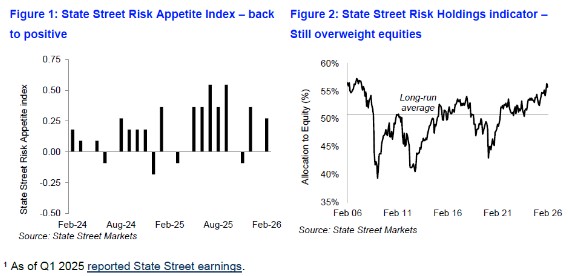

The State Street Risk Appetite Index improved slightly in February to move back into positive territory having been balanced in January. Despite this, the State Street Risk Holding Indicator shows that allocations to equities did decline marginally during the month in favour of a small shift to fixed income assets. Cash allocations were largely unchanged. Fresh concerns about valuations and the impact of AI on a number of stocks largely explain these moves. However, overall equity allocations remain extremely high compared with historical norms. In FX the persistent selling of the dollar mostly continued through the month.
Comments from Lee Ferridge, Head Macro Strategy in The Americas, State Street Markets:
"2026 thus far has been fairly hard going for financial markets generally, with stocks largely sideways, longer end yields virtually unchanged and central banks broadly on hold. FX markets have been similarly moribund, with the DXY USD index closing in February at pretty much where it started the year. That being the case, it is hardly a surprise that our Risk Appetite index has spent recent months bouncing between neutral and slightly positive (Figure 1). As if to further illustrate the point, within the month, the asset allocation weight to equities, the riskiest class of assets, was virtually unchanged; while the same is true for allocations to cash and fixed income assets. An unchanged allocation to equities, however, means that investors are still overweight risk as the prevailing portfolio share invested in equities is close to its highest level in 20 years (Figure 2). These broad conclusions are backed by our wider suite of behavioral indicators. Our cross-asset Behavioral Risk Scorecard (BRS) shows sentiment as largely positive but, with the odd dip into neutral or slightly negative territory in recent weeks. At the same time, however, the BRS shows that overweight positioning in risky assets is now close to its most extended since 2018. Again, real money investors are happy to remain overweight risk but, more recently, are reluctant to add significantly to these positions.
While the overall allocation to equities remained largely unchanged in the month we are seeing considerable rotation within sectors. As the market has increasingly focused on the potential winners and losers from AI we have seen a sharp move out of software stocks, with positioning in software now at its biggest underweight since the Dot Com crash. We have also seen a move out of semi-conductor stocks in favor of a move to tech hardware. This is not a generalized move out of technology related equities, but rather a rotation within technology related stocks. In terms of positioning, the overweight in US stocks persists, although that in Japan is now more extended than in the US. Real money investors remain underweight EM equities.
Appetite for fixed income assets, while largely unchanged in the month, remains tepid. This is particularly true for the US where investors are underweight US Treasuries and continued to sell during February. Positioning in USTs has only been more underweight than current levels in 5% of the time over the last five years.
As with Treasuries, institutional investors continue to shun the USD, despite existing heavily underweight positioning. Holdings of the USD remain close to their pronounced underweight since 2021. In relative terms, the USD underweight is easily the most significant of all the major currencies. The announcement that Kevin Warsh has been picked to lead the Federal Reserve from June onwards has done little to change expectations that the Fed will cut rates more aggressively than all other G10 central banks in 2026 which has certainly added to the negative dollar sentiment. On the other side of the dollar equation we continue to see strong buying of the EUR, despite an existing overweight. However, we did see some unwinding of overweight AUD positions in the month in the face of an extended AUD overweight. Positioning in the JPY remains underweight."