



"Markets have taken de-escalatory signals as confirmation of an imminent end to the war. While the parameters of a cease-fire are indeed shaping up, the duration of the energy shock remains uncertain and the timeline for the normalisation in energy flows could exceed consensus expectations," says Elliot Hentov, Chief Macro Policy Strategist at State Street Investment Management.
GEOPOLITICS
Observers at this stage in the conflict – i.e. the likely beginnings of a US-Iranian dialogue – may note that most of the regime’s assassinated as well as surviving leadership is still largely composed of the original veterans of the 1979 Revolution and the Iran-Iraq War. Regime survival instincts are central and pragmatism rules in times of crisis. At the same time, the history of the Islamic Republic’s negotiation tactics do reveal consistent patterns. First, they prefer to dictate the time frame, almost always extending negotiations beyond their counterparts’ wishes or expectations; to force a sense of ‘impatience’ on their counterparts to get a better deal. Second, the elite is relatively insulated from global discourse and, partly as a result, has a track record of overstating its bargaining position. Third, conventional national interests (e.g. economic or environmental hardships) factor little into elite thinking and can be sacrificed for the sake of leverage.
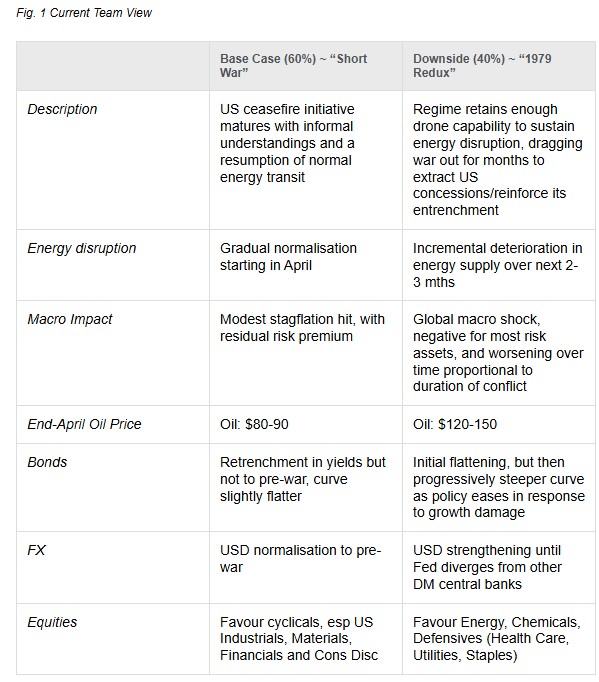
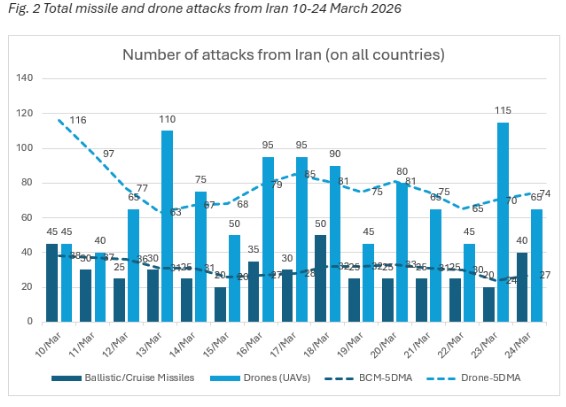
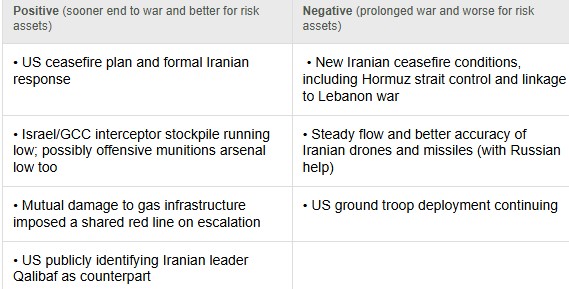
Hence, our relatively high odds (40%) that a cease-fire does not succeed anytime soon. We see the base case (60%) as potentially an arrangement led by the US halting fire and Iran permitting the resumption of energy transit. However, we can also imagine a dynamic where Tehran imposes demands that the US cannot tolerate, thereby inviting further escalation. The US cease-fire proposal largely resembled pre-war demands, with the exception of an improved promise of full sanctions relief. The initial Iranian response widened the gap by including new conditions, such as recognising Iranian control of the Hormuz Strait and halting the Israeli war against Hezbollah. Continued paralysis of shipping and relatively steady missile/drone fire gives the regime high confidence that they can sustain the status quo. Fig. 2 just shows Iranian fire over the past two weeks with the 5-day moving average emphasising a steady level. It makes possible a scenario whereby active fire declines, but shipping remains closed.
COMMODITY ECONOMICS:
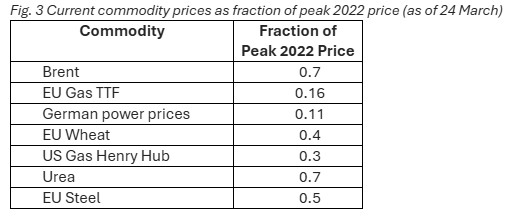
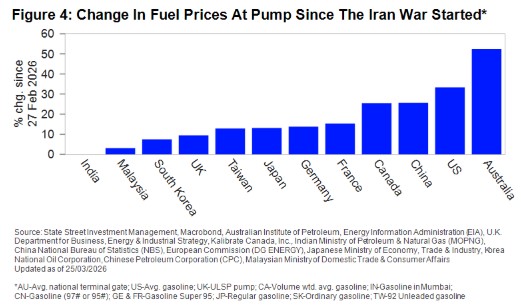
The macro story has largely already been told. To reiterate, what matters is the duration of the conflict and related energy outage. We have not yet seen a material supply shock, largely just a price shock. Moreover, even that has been relatively mild thus far. It remains far below the shock in 2022 but would easily eclipse it if the Hormuz straits are still shut by mid-May. For key raw commodities, below is a table comparing today’s prices to peak 2022, showing a milder impact across the board. For refined products, the comparison is consistently on the higher end of the spectrum, in the 0.7-0.8 range, i.e. close to 2022 experience. Some type of fuels, such as jet fuel have already hit the 2022 peak, which is why Fig. 4 shows a strong jump in “prices at the pump”. And this is all just within the benign base case of a relatively short war, so a protracted war still carries large downside potential.
Long term, even with a short war, the energy complex will not be returning to normal. First, there will be a permanent risk premium on Gulf energy as Iran risk will not go to zero. Second, higher inventory and redundancy costs globally. Third, renewed tailwinds for oil/gas alternatives, ranging from nuclear, alternatives and even preserving local coal production. This is basically a mini energy transition shock regardless of outcome, which is a drag on the global supply side of the economy.
MARKETS
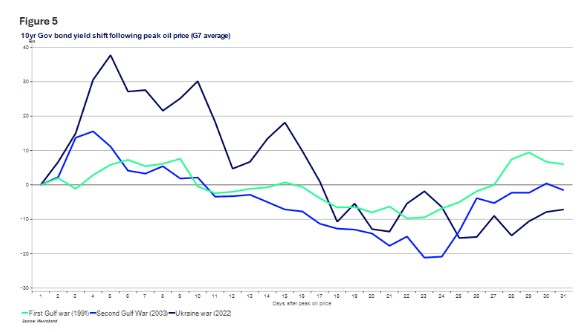
This week markets were calmer than in previous weeks, with most headline volatility indices lower than at close last week. We continue to expect the sharpest reaction to be in bond markets if indeed the war looks likely to wind down. Looking at previous oil shocks, bond yields always declined after oil prices peak (though only after continuing to climb for a few days), with Fig. 5 showing the decline (peak to trough) of 45 bps in 2022 and 35 bps in 2003 and 20 bps in 1991 within about a month of the day that oil prices peaked. Applied to this year, that would yields falling by 20 to 45 bps in the days after oil price peaks.
Bottom Line:
Both beginnings and ends to wars carry surprises. Yes, current momentum points to conflict de-escalation, but outlook for normalisation of energy barely looks better than last week.
