


Pictet Asset Management
A new wave of major technology initial public offerings (IPOs) this year is poised to reshape the investment landscape. SpaceX, OpenAI, and Anthropic are preparing to go public, with SpaceX’s anticipated listing potentially set to become the largest on record. These offerings are expected to attract significant investor interest, drive shifts in index composition, and reinforce the dominance of the technology sector. The expected listings follow recent earnings from leading artificial intelligence (AI) “hyperscalers” which have been buoyed by substantial “other income” linked to rising valuations of private investments in companies such as OpenAI and Anthropic. This underscores the sector’s growing financial interconnectedness.
Going public
SpaceX has filed for an IPO that could potentially be the largest in history, marking the start of a wave of major technology IPOs that could reconfigure Wall Street indices. While the size of the offering and the proposed valuation have not been disclosed, reports suggest a target of USD 1.75 tn. This filing is expected to kick off a blockbuster year for IPOs, with OpenAI and Anthropic also preparing to float their shares. These companies are at the forefront of AI and space technology, and their market debuts are expected to attract substantial investor attention.
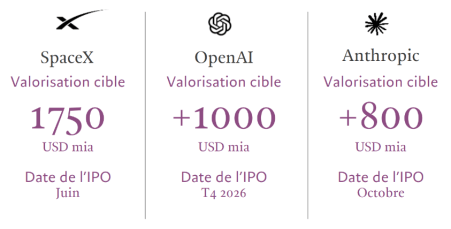
The influx of new tech listings could further boost the leadership of the technology sector when these stocks are included in the major indices. While the market capitalisation of these companies is significant, the actual proportion of each company to be sold in the IPO, the so called free float, is likely to be far smaller. Indeed, while SpaceX is potentially valued as USD 1.75 tn, only about USD 75 bn or 4.3% is due to go public. When, how and if these three mammoths enter blue-chip indices remains to be seen. Currently, they may not fulfil the necessary criteria for entry into major indices, or only after a potentially long delay.
With existing index rules likely to result in a significant lag before these companies are included, major index providers are now under pressure to revise their long-standing admission criteria to ensure they do not miss out on these landmark listings. Notably, as at 1 May 2026, the NASDAQ Composite Index has removed its long-standing barriers for large private companies to enter the index after going public. Under its new “fast-entry” rule, NASDAQ will wait at least 15 trading days before adding any IPO to its index compared to at least three months under the previous requirement. Further, rather than just adding the free float to the index calculation, it may apply a boosting factor of up to three times to increase the share of new entrants, hence increasing potential demand way beyond the actual liquidity in the stock. It remains unclear how other indices will respond.
What goes around comes around
The AI industry has developed a complex web of circular financial arrangements, with suppliers funding customers and customers, in turn, funding suppliers – raising concerns about stability and sustainability. These arrangements include supplier financing, rising customer concentration, long-term purchase commitments, revenue-sharing agreements, take-or-pay contracts, vendor repurchase deals, content licensing in exchange for model access, and third-party guarantees. Collectively, such arrangements allow participants to scale infrastructure well beyond what their individual cash flows would otherwise permit.
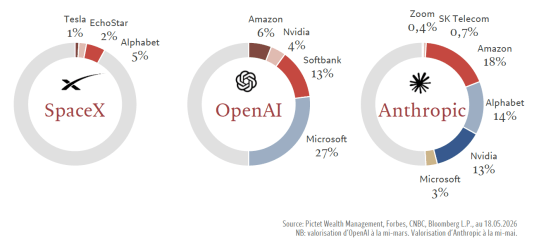
This circularity has also blurred the lines between public and private markets. Publicly listed technology hyperscalers have become significant conduits for exposure to private AI valuations, with meaningful financial consequences.
A notable example involves Alphabet and Amazon , both of which have taken large stakes in Anthropic. As Anthropic’s valuation has risen, these companies have been able to mark up the value of their existing stakes.
This environment has had an impact on the recent earnings performance of leading AI hyperscalers. Both sales and profits have exceeded expectations, but a closer look reveals that a considerable share of this growth stems from “other income” – primarily linked to the revaluation of private investments in companies such as OpenAI and Anthropic.
This trend highlights the increasingly interconnected nature of the AI sector, where private investments and funding rounds are now a key component of overall earnings. The capital provided by these large tech players has, in turn, enabled AI companies to secure major computing contracts with cloud providers such as Alphabet Cloud, Microsoft Azure, and Amazon Web Services. As a result, OpenAI and Anthropic now represent a significant share of the cloud computing business for several of the industry’s largest providers.
Conclusion
The forthcoming IPOs of SpaceX, OpenAI, and Anthropic mark a pivotal moment for technology markets, offering investors new opportunities but also introducing new complexities. These listings are expected to further cement the sector’s leadership. However, the increasingly circular financial relationships and deepening interdependence within the AI ecosystem underscore the importance of rigorous analysis. Investors should remain vigilant, balancing enthusiasm for innovation with prudent risk management as the market digests this new wave of tech listings.
3 THINGS TO KNOW:
- A wave of major tech IPOs is set to attract substantial investor interest, reshape index composition, and reinforce the dominance of the tech sector.
- The AI industry’s complex web of circular financial arrangements has boosted earnings for leading tech firms thanks to the upward revaluation of stakes they hold in private companies.
- These developments highlight the sector’s growing financial interconnectedness and the need for investors to balance enthusiasm for innovation with careful risk management.
