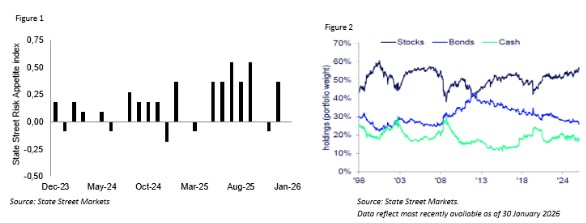

The Institutional Investor Risk Appetite Indicator declined to a neutral 0 in January 2026 from a +0.36 reading in the previous month (see Figure 1). January was notable for a strong pick-up in institutional risk exposure towards mid-month, but the combination of uncertainty around Federal Reserve policy and liquidity concerns across certain markets drove a more moderate risk stance as we approached the end of the month. That said, the Institutional Investor Holdings Indicator shows overall allocation exposure to equities continued to rise, while allocations to bonds and cash decreased further (see Figure 2).
Comments from Dwyfor Evans, Head of APAC Macro Strategy, State Street Markets:
"Several notable trends emerged from investor behavior in January. Firstly, institutional investors increased their exposure to risk towards mid-month but this exuberance for risk slowed as we approached month-end given uncertainty over the Fed Chair nomination, market liquidity and valuations. That said, investors ended the month with equity allocations at their highest since October 2007 and bond allocations at their lowest since August 2008. The equity-bond allocation divergence continues apace. The USD remained on the back foot and lost further ground over the month despite less extensive USD selling towards January month-end. The narrative around USD diversification persists. Meanwhile, appetite for USD fixed income assets remained weak with institutional flows falling towards the bottom quintile by end-January.
"Investors remain overweight US equities, and cross-border equity flows to Europe held up well on an absolute basis, but was generally weaker than the US, Japan and Oceania. This may reflect continued concerns about weaker growth rates and regional earnings and margins. Positioning in the EUR remains extremely overweight, but flows have weakened anew, and this puts extended positioning at some risk of unwind. Both flows and positioning and underwhelming for GBP, while the flow profile for the CHF is the strongest across G10, a reflection of a modest lurch into a more defensive stance at month-end. In APAC, demand for Japanese equities has remained positive and have yet to be impacted by the currency intervention in the JPY. Positioning in the JPY remains a modest underweight. There was a sharp rebound in demand for equities in Australia and New Zealand, where currency positioning is also extended in the AUD and NZD. Despite a continued strong performance by tech-related regional equity markets, e.g. China, South Korea and Taiwan, cross-border equity flows have remained relatively muted but regional currency positioning profiles show a stark contrast between extreme overweights (KRW, TWD and MYR) and extreme underweights (INR, PHP) and aligns with tech exposure."