



By François Rimeu, Senior Strategist, Crédit Mutuel Asset Management
Crédit Mutuel Asset Management is an asset management company of Groupe La Française, the holding company of the asset management business line of Credit Mutuel Alliance Fédérale. Before exploring where the dollar might be headed, we first need to analyze the reasons behind the decline of the currency over the past 12 months. Economic theory tells us that exchange‑rate movements are driven by different factors, and that the importance of these factors varies over time. This explains why it is difficult to generate stable and robust performance when investing solely in currencies. However, not all factors carry the same weight or have the same predictive power. From our perspective, the most reliable indicator is the spread between short‑term real interest rates (adjusted for inflation). When we run a trend analysis between the 2‑year real interest rate spread (U.S. vs. Eurozone) and currency movements over the past five years, the data reveals a clear and strong correlation.
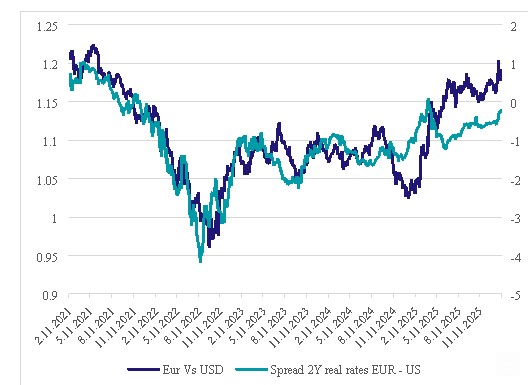
Source Bloomberg, 10/02/2026. Historical market trends are not a reliable indicator of future market behavior. This data is provided for illustration purposes only. Depending on the publication date, the information presented may differ from updated data.
Are there instances when the data departs from real-rate expectations? Yes, and these deviations are often driven by political, monetary or other external events. This is exactly what occurred during Trump’s election, when the dollar surged, and later during the post–Liberation Day period, when it weakened markedly.
However, all of this is ultimately just noise around the underlying trend suggested by the real‑rate differential. In 2025, U.S. 2‑year real rates fell from 1.68% to 1.15%, while Eurozone real rates increased from 0.28% to 0.60%. As a result, euro‑denominated returns improved as dollar‑denominated returns weakened. This narrowing of the real‑rate spread from 140 basis points (bps) to 55 bps translated into the euro appreciating from 1.10 to 1.15 against the dollar, a coherent outcome. (Source: Bloomberg)
In 2026, we expect U.S. short‑term real interest rates to continue declining, while Eurozone short‑term real rates should remain stable. This should lead to a further depreciation of the dollar against the euro in 2026, although less pronounced than over the past 12 months.
